
The History Of Hyde Tools… Isaac P. Hyde’s Dream Becomes Reality
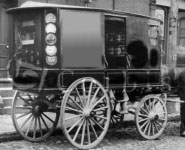
 He began in 1875 as an engineer, craftsman, salesman and deliveryman. In those early days, Isaac P. Hyde did everything.
New England’s leather and shoe industry needed high-quality knives to cut and shape its wares. Hyde saw the need and filled it. By budgeting his time, he could fashion the knives by hand, finish them, load them in his buggy, distribute them, factory to factory, and get back to Southbridge in time to sweep up the workshop.
From this modest beginning, Hyde built first a reputation, then a factory. By the close of the 19th century, he had expanded his line of knives to include custom styles for a variety of industrial uses. In 1917 another factory was built, this one in the shape of the letter H. Beyond the initial coincidence of that shape and the company name, the new building was designed for efficient work flow, improved illumination and expected expansion.
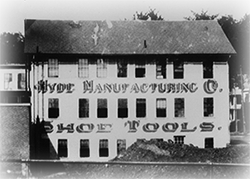 And expand Hyde did. In 1927, Hyde added its renowned painting and decorating tools to the product range. Today, Hyde is into its second century of service to American industry and the home handyman. To the uninitiated, the variety of uses for Hyde products is astonishing. In fact, if it’s made of paper, cloth, plastic, leather, or rubber chances are a Hyde blade was involved in its manufacture. Likewise, Hyde helps harvest and process a wide variety of food products around the world. The diamond wheel industry relies on Hyde for the steel centers used to make their product runs straight and true.
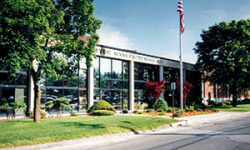 Today, Hyde is the largest manufacturer of industrial machine and hand knives and fix-up-paint-up tools and decorating aids. Hyde has come a long way from its humble beginning in 1875. With well over a century of manufacturing precision made knives for industry, Hyde has the know-how to produce better quality hand tools.
Hyde Timeline
1870 – Isaac P. Hyde establishes his company in Southbridge, Massachusetts, making knives for local industries.
1893 – Mr. Hyde sells his company to the LaCroix and Clemence families; the industrial knife product range is expanded.
1917 – The company moves into a modern new one-floor, H-layout building, designed for efficient work flow and improved illumination.
1925 – The H-layout is filled in with additions.
1927 – Hyde introduces its now-famous painting and decorating tools.
1953 – The factory gets a new large addition for the grinding department and machine shop.
1956 – Hyde introduces the “Card-O-Sell” packaging system.
1957 – Another addition is completed, housing the warehouse, engineering and computer department.
1960 – The shipping facility is enlarged; the executive offices are added.
1966 – A large new addition houses the heat treating department which is equipped with all-new equipment.
1968 – The Russell Harrington Cutlery Co. of Southbridge is acquired.
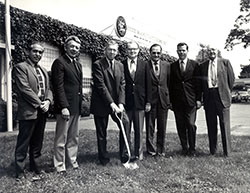 1974 – The new plant on Eastford Road is dedicated.
1975 – Hyde celebrates its 100th Year of Progress.
1978 – The heat treating department undergoes a major expansion.
1979 – The circular grinding department undergoes an expansion.
1980 – The Wilson Machine Knife Co., Inc. is acquired.
1981 – Gutmann Cutlery, Inc. is acquired.
1983 – The Exact Level Co. is acquired.
1984 – A new warehouse expansion is added to the plant.
1988 – Beaut-Ease Products is acquired.
1990 – Customer Focused Teams Installed.
1991 – The Exact Level division is divested.
1998 – The American Paint Paddle Co. is acquired.
1999 – Hyde attains ISO 9001 Registration.
2000 – Hyde celebrates its 125th Anniversary.
2001 – The Russell-Harrington Cutlery Co. is renamed Dexter-Russell, Inc.
2003 – Hyde Mfg. Co. becomes the corporate parent of The Hyde Group of companies.
2003 – The Wilson Machine Knife division is relocated to Southbridge.
2003 – A. Richard Ltd. is acquired (Mr. Richard, the founder, started his company after moving to Quebec in 1890, having spent 5 years learning his trade from Isaac Hyde).
2005 – Roman Decorating Products is acquired.
2005 – Hyde’s painting and decorating tools undergo a major re-branding, modernizing this well known and respected brand.
2009 – Hyde’s Industrial Blade Solutions division embarks on a major expansion.
2016 – D&S Manufacturing and PDK Design & Grinding are acquired.
2022- Hyde Industrial Blade Solutions Merger With Applied Cutting.
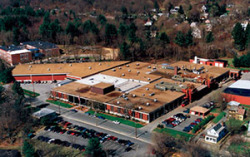 The essence of Hyde’s success is concentrating on what we know best; laser cutting, blanking, heat treating, grinding and polishing steel. The standards that Isaac Hyde established in the 1870’s still hold true today: Make the best possible product from the most appropriate steel and try every day to improve on yesterday’s best.
Day after day, in every product, Hyde gives America the edge it needs.
For more on Hyde Blades and Hyde Knives, click here.